
Machining Factory Sourcing: What to Verify Before You Pay
Most machining sourcing failures are not machining failures. They are verification failures: the deposit went to an entity that was never checked, the tolerance claim was accepted without a CMM report behind it, the finishing step that quietly left the floor was never named, or the payment terms let a problem surface after the money moved. Each of those is preventable, and each is preventable before you pay.
Why is verification the part of the price you cannot skip?
A machined part can fail you in ways no per-part price shows — the supplier that drifts on quality over a long run, the single source that cannot cover a breakdown, the lot that fails and cannot be traced. When the factory is in China and the parts are shipped to your dock, every one of those failures costs more to recover: the inspection you redo, the re-run, the air-freight leg, the schedule slip. Verification is the part of the price spent before the order, and it is the cheapest line in the whole program because it converts unknown supplier risk into known, documented capability.
The order matters. Run the checks in sequence — entity, floor, tolerance evidence, material control, finishing chain, terms, trial — because each check builds on the last and each catches a different failure mode. A factory that passes the entity check but fails the tolerance check is a real factory that cannot prove your part; a desk that fails the entity check never reaches the tolerance question. Verification is not one document; it is a ladder, and every rung that holds makes the next one meaningful.
What should you verify about the entity before the first deposit?
The entity check is the first rung, and it is where most of the risk of dealing with a middleman is removed. A real machining factory names its legal entity, its registration or business ID, and a specific street address. Ask for all three in writing, then check them independently: in China the registration number is searchable in the public business registry, and the address should be a real, specific location rather than a district or a city name. Check the certificates by looking for the registrar and the certificate number rather than accepting the logo — ISO and IATF certificates carry a number that can be confirmed with the certifying body.
Then add evidence only a manufacturer has. Ask for the machine list with models, and for a live video walkthrough of the floor if the site does not show one. Ask which machines would run your specific part — a manufacturer names the model; a trading desk names a category. Ask for a sample inspection report from a completed job, with the factory's name on it. Each of these checks is individually defeatable, which is why you run all of them: a trading desk that fakes the registration, the address, the certificates, and the machine list for a one-off inquiry is rare, because the effort exceeds the margin. The factory behind this site is documented on the factory page, which is the kind of entity-level evidence a buyer should collect from any candidate.
How do you verify the floor behind the machine list?
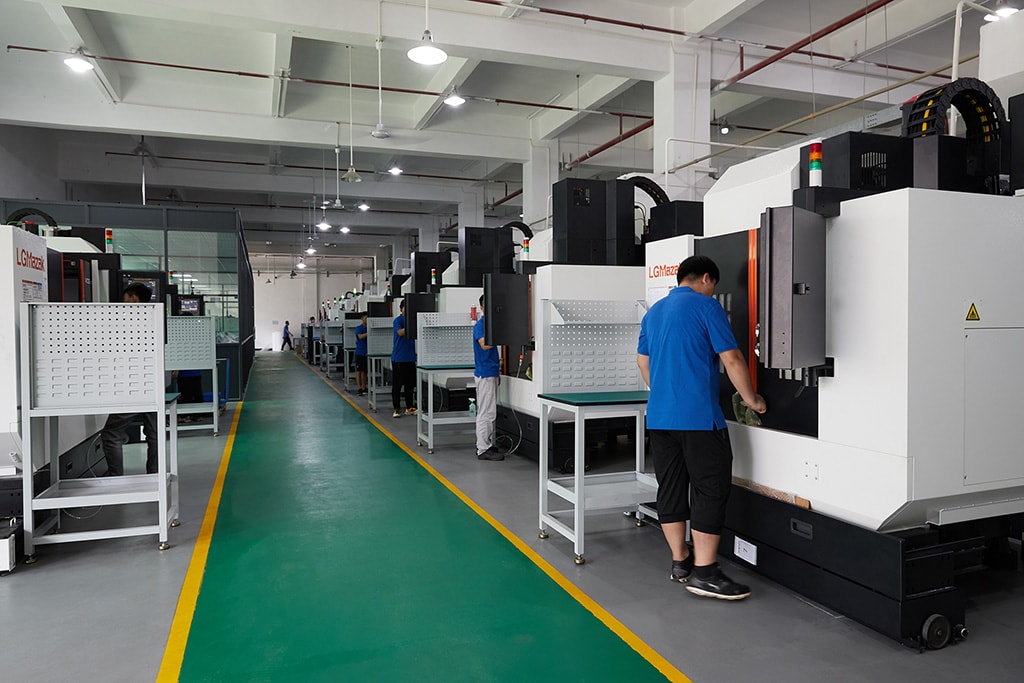
The machine list is only the beginning; the floor is where the list becomes real. Verification here is about matching documents to physical reality, and for a distant buyer the tools are the video walkthrough and the targeted question. Ask for a live or recorded video of the specific machine types your part would run on, and ask the walkthrough host to count machines aloud as the camera passes them — a floor with 100+ machines can be counted, a brochure cannot. Ask how the floor is organized: which machines run the high-volume work, which run the prototypes, and where the metrology bench sits relative to the machines.
Ask what happens when a machine breaks down. A factory with process redundancy — several machines of the same class, or turning, milling, and grinding that can be routed across the floor — can absorb a breakdown without lying about a date; a factory with one machine for your part cannot. The machine mix is also the price story: a floor that runs milling, turning, mill-turn, and grinding side by side can route each feature to the process that cuts it cheapest and holds it tightest, which is what keeps a quote honest. The capability range of a single floor is described on the services overview.
What tolerance evidence should a factory show before you trust its claim?
The single most common sourcing error is accepting a tolerance claim without asking how it is measured. Every factory can say it holds ±0.003 mm; the ones that actually do can show you how. Milling and turning hold fit and alignment features to ±0.003 mm in controlled production, with process capability demonstrated at Ppk ≥ 1.67 at the initial study on key characteristics and Cpk ≥ 1.33 on general characteristics. Capability is reported per characteristic: every report names the feature, its tolerance band, the sample size, the sigma method, and the study window., and features that need a ground surface condition or tighter size move to precision grinding at ±0.002 mm. Those numbers are only real if the measurement behind them is real.
Ask for the evidence in a specific form: a dimensional report from a completed job that shows measured values against the toleranced callouts, not a pass/fail tick list; the instrument that produced the numbers — a named CMM, not a caliper; and, where capability is claimed, the sample size and the characteristics tracked. A CMM report with a factory name and a part number is evidence. A statement that "we hold high precision" is not. The quality page on this site shows how critical dimensions are verified and what a measured report looks like, which is the standard a buyer should hold any candidate to. Ask for a sample report from a part in the same material family as yours, and read it the way an auditor will read it, because a tolerance claim without a measurement plan behind it is a late-rework risk.
How do you verify material control and traceability?
Material is where the hidden substitutions happen, and the verification is the receiving gate. Ask how the factory verifies incoming stock against its mill certificate — the reliable pattern is XRF analysis of the incoming lot before cutting — and how the heat or lot number follows the work from bar to finished part. Ask for an example of the incoming verification record from a past lot, and check that the heat number on the record matches the certificate number and the work order. When a part can be traced to its raw lot, its machine, and its operator in a one-line answer, the traceability is real; when the answer requires a warehouse tour, it is a folder.
Traceability is not a paperwork afterthought; it is a containment mechanism. A part that cannot be traced is a part whose failure cannot be contained, and a factory whose lot records are a system rather than a folder is a factory whose failures stay small. On an offshore order the containment question matters more, because a failure discovered at your dock is a failure you cannot investigate with a phone call. Confirm the material control story in writing before the order, and confirm it again on the first shipment by checking that the certificate, the verification record, and the dimensional report all line up to one lot.
Which finishing and heat-treatment handoffs must be named before you pay?
Finishing and heat treatment are where the part leaves the machining floor, and every handoff is a place where quality, schedule, and traceability can drift. The verification question is simple: who performs each step, and what records prove it? A factory that runs anodizing, passivation, plating, and heat treatment through named, qualified partners should be able to name the partner and the process specification for each. A factory that folds finishing into a vague "included" has not told you which process, what allowance, or who performs it, and on an offshore order, a handoff you cannot name is a risk you cannot price.
Ask how the finished part is verified after the treatment, because coating changes the inspection story: coating thickness is measured after the coating is applied, a plated thread is verified differently from a machined surface, and anodize growth can push a tight feature out of the band that was machined in. Each treatment should carry its own certificate and its own dimensional effect, and both should be on the RFQ, not discovered after the parts are machined. The process range behind the finishing chain is on the services overview, and the material trade that decides whether a finish is even needed is in the aluminum vs stainless decision table.
What terms should be in writing before the first payment?
The commercial terms belong in the order, not discovered later, and on a China machining order they carry extra weight because the distance makes informal correction impossible. State the drawing revision, the material grade and condition, the quantity, the finish, and the incoterm — EXW, FOB, and DDP move the duty and freight risk differently, and DDP shifts the whole logistics chain to the supplier. State what happens if the drawing changes after the order, and who pays for the revision loop. State the documentation that ships with each lot — material certificate, inspection report, conformity statement — and the payment structure that ties each milestone to evidence.
The payment structure is the practical control. Structure the first order with a deposit that matches the entity you verified, a milestone against first-article approval, and the balance against pre-shipment evidence such as the dimensional report, photos, and the packing list. Keep the trial order small enough that the deposit is proportionate to the risk — a one-part trial at the minimum order is the standard way to test everything you verified at the cost of one piece. A factory that welcomes the staged structure is one whose claims survive contact with real parts; one that pressures for full payment up front is telling you what the verification already suspected.
What should the first trial order prove, and how do you close the loop?
The trial order is where verification becomes concrete. One part, at the minimum order of one piece, machined to the production tolerances and material, with the first-article report, the material certificate, and the dimensional evidence included. The trial proves what the document review and the video walkthrough could not: that the factory machines your geometry to your tolerances and ships the paperwork your quality system requires. It is the cheapest possible full test of the supplier, because it exercises the entity, the floor, the material control, the inspection, and the documentation in one order.
Two rules make the trial a genuine test rather than a sample. First, machine it to the production tolerances and the production material, so the part you validate is the part that repeats. Second, read the trial as a decision input: the CMM report, the material certificate, and the conformity statement are the evidence that closes the sourcing checklist. Keep the trial's records on file as the baseline every later lot is measured against. When the trial passes, the production order is a repeat of a proven process; when it fails, the trial has cost you one part instead of a batch, which is the whole point of verifying before you pay.
Which red flags should stop the sourcing process immediately?
Some signals are worth a second email; others should stop the process before the first payment. The first is an address that is not a specific location, or a refusal to state the legal entity. The second is tolerance claims without any measurement evidence after you ask — a factory that cannot produce a past inspection report is a factory that does not keep records. The third is a quote that will not itemize or will not name the routing. The fourth is a finishing or heat-treatment chain that cannot be named. The fifth is a payment structure that demands full payment up front from an unproven supplier. The sixth is a price so far below the market that the geometry cannot have been priced honestly.
None of these red flags is about nationality or size; they are about information discipline. A small real manufacturer answers direct questions with specifics because it runs the machines and owns the records. A large trading operation answers with generalities because it has never loaded your part. The buyer's job is to reward the factory that shows its work — in the website, in the entity documents, in the video walkthrough, in the sample report, and in the itemized quote — because that behavior is exactly what will continue through production, inspection, and delivery. The cost logic behind the same sourcing decision is in the machining factory cost guide, and the medical and aerospace programs that need the strictest version of this checklist are covered in the medical machining guide and the aerospace materials guide on this site.
Frequently Asked Questions
What should I verify before paying a machining factory for the first time?
Verify the entity and registration, the machine list matched to the floor, the tolerance claim with CMM or SPC evidence, the material control at receiving, the finishing and heat-treatment partners, the traceability record, the incoterm and payment terms, and the first-article plan. Run these in writing before the first deposit.
How do I verify a machining factory is real from a distance?
Check the registration or business ID against the public registry, confirm a specific street address, verify certificate numbers with the registrar, ask for the machine list with models, and request a live video walkthrough of the floor. A real factory passes each check; a desk fails on one of them.
What tolerance evidence should a machining factory show?
A CMM report from a completed job with measured values on toleranced callouts, and capability data at Ppk ≥ 1.67 at the initial study on key characteristics and Cpk ≥ 1.33 on general characteristics. Capability is reported per characteristic: every report names the feature, its tolerance band, the sample size, the sigma method, and the study window. Milling and turning hold fit features to ±0.003 mm; grinding reaches ±0.002 mm. A sample report is worth more than any capability statement.
How do I verify material control at a machining factory?
Ask how incoming stock is verified against its mill certificate — for example by XRF analysis at receiving — and how the heat or lot number follows the work. Ask for an example of the incoming verification record from a past lot.
What payment terms are safe for a first machining order?
Structure the first order with a deposit, a milestone against the first article, and the balance against pre-shipment evidence such as the dimensional report and photos. Agree the incoterm explicitly, and keep the trial order small enough that the deposit is proportionate to the risk.
What should a first trial order include?
One part at the minimum order of one piece, machined to the production tolerances and material, with the first-article report, the material certificate, and the dimensional evidence included. The trial closes the documentation loop at the cost of one part.
What is the difference between a trading desk and a machining factory?
A machining factory owns the floor: the machines, the metrology, and the material control that make the part. A trading desk adds a margin and removes accountability. The verification checks — entity, machine list, video walkthrough, inspection evidence — are designed to expose the difference.
How do I handle payment for a machining order when the supplier is in China?
Use a documented deposit with bank details matching the legal entity, tie the milestone payments to first-article approval and pre-shipment evidence, and state the incoterm and freight leg in the PO. Keep the trial order small so the first payment is a test of the supplier, not a bet.
Want to run this sourcing checklist against a real machining factory?
Send your drawing and your verification list to [email protected] or call +86 13126536955. You will get the entity documents, the machine list, a video walkthrough of the floor, sample inspection reports, and an itemized quote with the trial-order tier — everything this guide says to collect before you pay.